

By Imran Younas
In March 2023, the United States faced its most serious banking crisis since the collapse of several major financial institutions during the global financial crisis of 2008. The sudden failure of Silicon Valley Bank (SVB), followed closely by the collapse of Signature Bank, triggered fears of widespread instability throughout the American financial system. Investors panicked, depositors rushed to withdraw funds, and financial markets reacted with uncertainty. For a brief period, policymakers confronted a troubling question: Was the United States on the verge of another banking crisis?
The response of the Biden administration during those critical days became one of the defining political and economic events of the first half of 2023. Through swift coordination among the White House, the Treasury Department, the Federal Reserve, and the Federal Deposit Insurance Corporation (FDIC), the administration sought to contain panic, restore confidence, and prevent financial contagion from spreading across the banking sector. Supporters of the administration argue that these actions helped avert a broader crisis and demonstrated the value of decisive government intervention during moments of economic uncertainty.
The origins of Silicon Valley Bank’s collapse were rooted in a combination of economic changes and management decisions. During the years of exceptionally low interest rates, SVB had become a preferred financial institution for technology startups, venture capital firms, and innovation-focused businesses. Flush with deposits, the bank invested heavily in long-term government securities and other assets.
However, as the Federal Reserve aggressively raised interest rates to combat inflation in 2022 and early 2023, the value of many of these long-term assets declined. At the same time, technology companies faced tighter financial conditions and began withdrawing deposits. The combination created mounting pressure on the bank’s balance sheet.
On March 8, 2023, Silicon Valley Bank announced significant losses on the sale of securities and plans to raise additional capital. Rather than reassuring investors, the announcement sparked concern. Venture capital firms advised portfolio companies to move their funds, and a classic bank run quickly emerged. Within days, depositors sought to withdraw tens of billions of dollars.
By March 10, regulators had seized Silicon Valley Bank, making it the second-largest bank failure in American history at the time. The collapse immediately sent shockwaves through financial markets. Investors worried that other regional banks might face similar vulnerabilities. Depositors across the country began questioning whether their funds were safe, particularly if their balances exceeded the FDIC’s standard insurance limit.
The crisis threatened more than just one financial institution. Silicon Valley Bank served thousands of businesses, many of which relied on access to deposits for payroll, operations, and daily expenses. Had those funds remained inaccessible, countless companies could have faced immediate financial distress.
Employees might have missed paychecks, suppliers could have gone unpaid, and economic disruption might have spread rapidly through important sectors of the economy.
Faced with this growing uncertainty, the Biden administration moved quickly. Throughout the weekend following SVB’s collapse, federal officials worked to develop a strategy that would restore confidence without triggering broader panic. Treasury Secretary Janet Yellen, Federal Reserve Chair Jerome Powell, and FDIC officials coordinated closely to evaluate risks and formulate a response.
On March 12, the administration announced a series of extraordinary measures. Most notably, regulators declared that all depositors at Silicon Valley Bank and Signature Bank would have full access to their funds, including deposits that exceeded the traditional FDIC insurance limit. The administration emphasized that taxpayers would not bear the costs of protecting depositors. Instead, losses would be covered through the banking system itself.
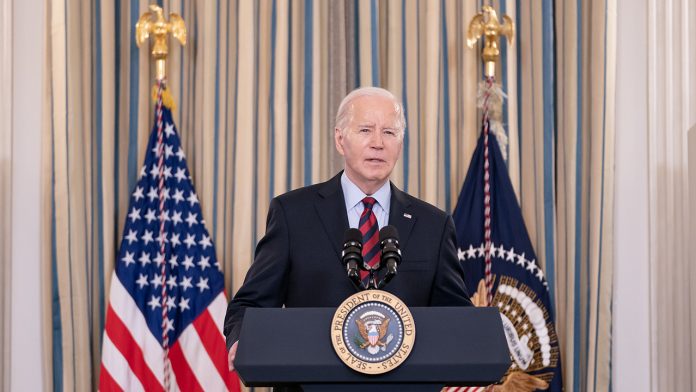
President Joe Biden addressed the nation shortly afterward, seeking to reassure Americans about the stability of the financial system. His message was straightforward and designed to calm public fears. Americans, he declared, could have confidence that the banking system remained safe and secure. At a moment when uncertainty threatened to fuel panic, the administration understood the importance of restoring trust.
One of the most significant aspects of the administration’s response was its effort to distinguish between protecting depositors and rescuing bank executives. Critics quickly accused the government of organizing another bank bailout. White House officials rejected that characterization. They emphasized that shareholders would not be protected, management teams would be removed, and executives responsible for failures would face consequences.
This distinction carried important political significance. The memory of the 2008 financial crisis remained fresh for many Americans, and policymakers understood the public’s frustration with institutions perceived as “too big to fail.” By ensuring that depositors were protected while investors and executives absorbed losses, the administration sought to balance financial stability with accountability.
The Federal Reserve simultaneously introduced a new emergency lending facility designed to provide liquidity to banks facing temporary stress. This initiative allowed financial institutions to borrow against high-quality assets without being forced to sell them at substantial losses. The program was intended to prevent liquidity challenges from escalating into solvency crises.
Financial markets initially remained volatile, but fears of a systemic collapse gradually subsided. While concerns persisted regarding several regional banks, the administration’s actions helped stabilize depositor confidence. The immediate threat of widespread bank runs diminished, and businesses regained access to critical funds.
Supporters of the Biden administration viewed the response as an example of effective crisis management. Rather than waiting for market forces alone to resolve the situation, federal officials acted decisively to contain uncertainty before it spread further. The administration recognized that confidence is one of the most valuable assets in any financial system. Once confidence disappears, panic can become self-reinforcing. By moving quickly, policymakers sought to prevent exactly that scenario.
The crisis also renewed debates about financial regulation. Biden and other administration officials argued that some banking safeguards had been weakened in previous years and suggested that stronger oversight could help prevent similar failures in the future. The administration called for tougher rules governing risk management, capital requirements, and executive accountability.
While political disagreements over regulation continued, there was broad recognition that the immediate crisis had been contained. What began as a sudden bank failure with the potential to trigger widespread panic ultimately did not evolve into a systemic financial collapse. The coordinated actions of federal agencies played a crucial role in achieving that outcome.
Looking back, the Silicon Valley Bank collapse represented one of the most significant economic challenges faced by the Biden administration during the first half of 2023. The speed of the crisis required rapid decision-making, clear communication, and coordinated action across multiple institutions. The administration’s response demonstrated how government intervention can help stabilize markets during periods of extraordinary uncertainty.
For supporters of President Biden, the episode highlighted the importance of experienced leadership during moments of financial stress. By acting quickly to protect depositors, maintain confidence, and prevent contagion, the administration helped steer the financial system away from a potentially dangerous path. Although debates about regulation and economic policy would continue, the events of March 2023 offered a powerful reminder that effective crisis management can make the difference between temporary disruption and lasting economic damage.
The writer is a journalist and an election observer and election analyst. He can be reached at: [email protected].