

By Imran Younas
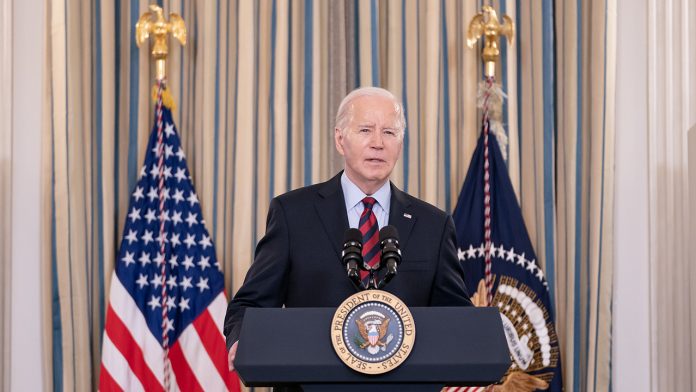
When President Joe Biden addressed Congress on February 7, 2023, for his second State of the Union address, he faced a challenging political landscape. Republicans had recently gained control of the House of Representatives, inflation remained a major concern for American families, and questions persisted about the strength of the post-pandemic economy. Yet Biden entered the House chamber with a message of confidence rather than caution. His address was not merely an update on government affairs; it was a comprehensive argument that the United States was experiencing a significant economic recovery and that his administration’s policies were helping to drive that progress.
The speech quickly emerged as one of the most important political events of the first half of 2023. It provided the administration with an opportunity to define its record, shape public perceptions of the economy, and establish priorities for the remainder of Biden’s term. For supporters of the administration, the address represented a persuasive defense of a governing strategy centered on investment, job creation, infrastructure development, and the revival of American manufacturing.
At the heart of Biden’s speech was a simple claim: America was stronger than it had been two years earlier. The President highlighted a series of economic indicators that his administration viewed as evidence of recovery. Unemployment had fallen to levels not seen in decades. Millions of jobs had been created since he entered office. Manufacturing investment was increasing, and major infrastructure projects were beginning to move forward across the country.
These achievements formed the foundation of Biden’s economic argument. Rather than presenting economic growth as an abstract statistic, he sought to connect policy decisions with tangible benefits for ordinary Americans. The administration’s investments in roads, bridges, ports, broadband access, and clean energy projects were described as long-term commitments designed to strengthen the nation’s competitiveness and create employment opportunities.
One of the most notable themes of the speech was the concept of rebuilding American manufacturing. Biden argued that the United States had spent too many years allowing critical industries to move overseas.
Through legislation such as the CHIPS and Science Act and the Inflation Reduction Act, the administration sought to encourage domestic production of semiconductors, clean-energy technologies, and advanced manufacturing components.
This message resonated particularly strongly in industrial regions that had experienced economic decline over previous decades. Biden framed manufacturing not only as an economic issue but also as a matter of national security and strategic independence. The disruptions caused by the COVID-19 pandemic had exposed vulnerabilities in global supply chains, and the administration argued that strengthening domestic production would help protect the country from future disruptions.
Another significant aspect of the speech was Biden’s emphasis on infrastructure investment. For years, politicians from both parties had spoken about the need to modernize America’s infrastructure, but many proposals failed to become law. Biden pointed to the Bipartisan Infrastructure Law as evidence that government could still deliver meaningful results. Across the country, projects involving highways, bridges, airports, public transportation systems, and internet access were beginning to take shape.
Supporters of the administration viewed this focus on infrastructure as one of Biden’s strongest political arguments. Infrastructure projects create visible and lasting improvements that often transcend partisan divisions. While voters may disagree on many issues, safer bridges, improved roads, and expanded broadband access generally enjoy broad public support. By emphasizing these projects, Biden sought to demonstrate that government investment could produce practical benefits for communities.
The speech also addressed one of the administration’s most persistent challenges: inflation. Throughout 2022, rising prices had placed significant pressure on households and created political difficulties for Democrats. Biden acknowledged these concerns while arguing that inflation was beginning to ease. He pointed to declining gasoline prices and efforts to strengthen supply chains as evidence that the situation was improving.
Critics argued that inflation remained too high and that the administration deserved some responsibility for rising prices. Nevertheless, Biden used the State of the Union to reassure Americans that his administration recognized the problem and was committed to addressing it. Rather than avoiding the issue, he incorporated it into a broader narrative of economic resilience and recovery.
Healthcare costs represented another major theme. Biden renewed calls to lower prescription drug prices and highlighted measures already enacted to reduce costs for seniors. By emphasizing healthcare affordability, the administration sought to connect economic policy with everyday concerns affecting millions of Americans. The message reflected a broader political strategy of focusing on kitchen-table issues rather than abstract policy debates.
Perhaps the most politically significant moments of the speech involved interactions with congressional Republicans. With a divided government now in place, Biden attempted to position himself as a pragmatic leader willing to work across party lines. He repeatedly emphasized areas where bipartisan cooperation might be possible, while also defending key achievements of his administration.
This approach reflected a central feature of Biden’s political identity. Throughout his career, he has often portrayed himself as a consensus-builder who values negotiation and institutional stability. The State of the Union allowed him to reinforce that image at a time when partisan polarization continued to dominate American politics.
The broader significance of the speech extended beyond individual policy proposals. It represented an effort to shape the national conversation about the economy. Public perceptions of economic conditions often differ from statistical measures, and Biden sought to persuade Americans that the country was moving in the right direction. By highlighting job growth, infrastructure projects, manufacturing investments, and declining unemployment, he attempted to create a narrative of progress and optimism.
The speech also carried clear implications for the future. Although the 2024 presidential election was still more than a year away, the State of the Union served as an early preview of the themes that would likely define Biden’s political message. Economic recovery, middle-class investment, domestic manufacturing, and bipartisan problem-solving all emerged as central elements of the administration’s case for continued leadership.
Looking back, the 2023 State of the Union address stands as one of the defining political moments of the year’s first half. It provided a comprehensive defense of the administration’s economic record and offered a vision for America’s future grounded in investment and growth. While critics challenged aspects of Biden’s analysis, supporters viewed the speech as a compelling argument that the nation was recovering from unprecedented challenges and building a stronger economic foundation for the years ahead.
For the Biden administration, the address was more than an annual constitutional obligation. It was an opportunity to make the case that government action, strategic investment, and long-term planning could help strengthen the American economy. In doing so, Biden sought not only to defend his record but also to persuade Americans that the country’s best days remained ahead.
The writer is a journalist and an election observer and election analyst. He can be reached at: [email protected]